Gaza Gravedigger Describes Burying 18,000 amid Israel’s War
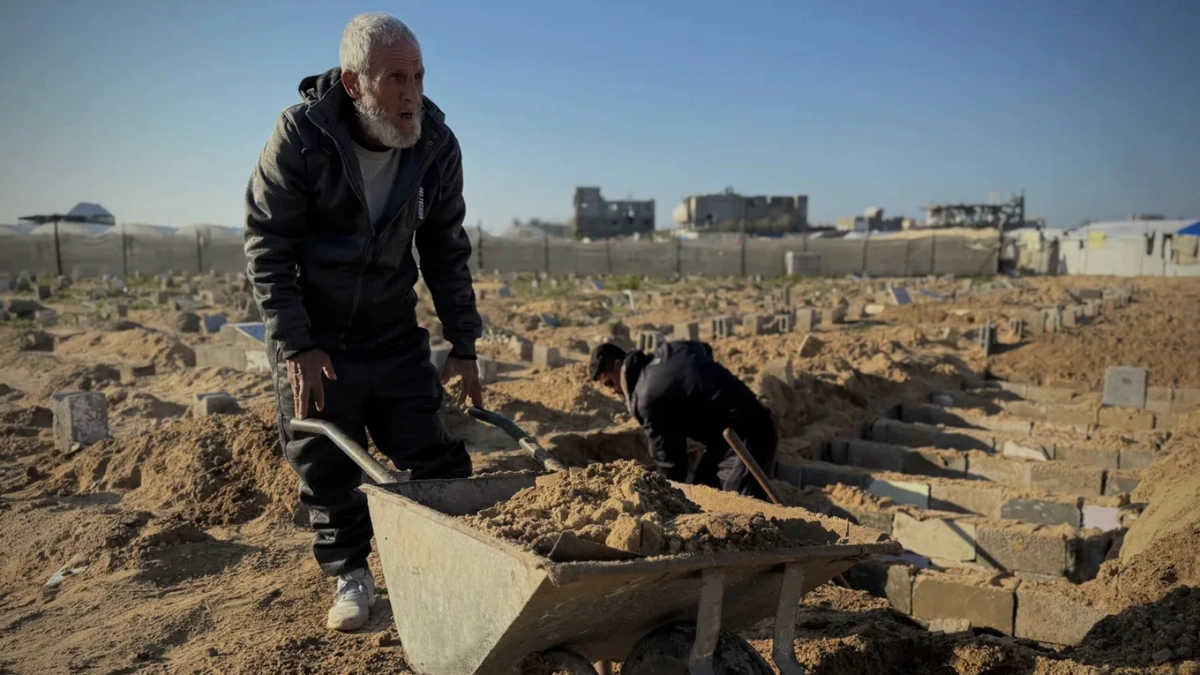
Calling the war the most brutal period of his career, which began in 2005, Abu Hatab said he personally oversaw the burial of between 17,000 and 18,000 Palestinians.
After burying close to 18,000 victims of Israel’s devastating war on Gaza, undertaker Yousef Abu Hatab has become a living witness to one of the darkest chapters in Palestinian history.
At 65, Abu Hatab continues his work in the southern city of Khan Younis, gripping a worn hoe with hands cracked from years of labour. As bodies arrived endlessly under Israeli bombardment, cemeteries filled beyond capacity, forcing him to dig wherever space could be found.
Many of those laid to rest had no identities. Their graves often held only scattered remains, torn apart by relentless airstrikes.
“We buried the dead under unimaginable pressure,” Abu Hatab told Anadolu. “Sometimes in mass graves, sometimes individually, sometimes even inside hospitals. The number of deaths was overwhelming.”
At the height of the assault, he said, as many as 15 bodies were placed into a single grave due to the intensity of the bombardment.
Calling the war the most brutal period of his career, which began in 2005, Abu Hatab said he personally oversaw the burial of between 17,000 and 18,000 Palestinians.
Since October 2023, nearly 71,000 Palestinians — most of them women and children — have been killed, with more than 171,000 wounded. The war left Gaza largely destroyed.
Although a ceasefire took effect on October 10, Israeli attacks have continued. Gaza’s Government Media Office reports that at least 405 Palestinians have been killed and more than 1,100 injured since the truce began.
Burials under siege
Abu Hatab begins work before sunrise and often continues until nightfall. With limited equipment, he frequently digs by hand, gathering broken stones and tiles from bombed buildings to reinforce graves and preserve the dignity of the dead.
“The conditions are unbearable,” he said. “There are no burial materials, no shrouds, no proper tools — all because of the blockade.”
While daily burials have decreased since the ceasefire, bodies still arrive regularly.
“At the peak of the war, we buried between 50 and 100 people every day,” he said. “Even now, the cemetery is never empty.”
One of the most harrowing episodes came during Israel’s siege of Nasser Hospital last year, when Abu Hatab buried approximately 550 bodies in a temporary grave within the hospital grounds.
Throughout the conflict, Palestinians were forced to bury their dead wherever possible - in neighbourhoods, courtyards, wedding halls and sports fields.
According to Gaza authorities, Israeli forces destroyed 40 of the enclave’s 60 cemeteries and removed the remains of more than 1,000 bodies. Officials say 529 victims were later exhumed from mass graves inside hospitals, while over 10,000 bodies remain trapped beneath rubble.
Despite the ceasefire, Israel continues to block Gaza’s crossings, preventing the entry of aid and materials needed for rebuilding.
Haunted by the dead
Working largely alone, Abu Hatab handles every step of the burial process -washing, shrouding, documenting and interring bodies — often recording evidence on his mobile phone.
“Sometimes all I had were plastic bags,” he said. “No stones, no cement -nothing.”
Among the moments that still haunt him was July, when he reopened family graves to bury nearly 1,270 bodies amid nonstop airstrikes.
He also recalled burying a mute woman alongside her four children. Two months later, a bag of unidentified remains arrived — which he placed in the same grave. Many bodies he buried were found in streets and alleyways, disfigured beyond recognition and, in some cases, partially eaten by animals.
The memories refuse to fade.“Some nights, I don’t sleep at all,” Abu Hatab said quietly. “The sounds of funerals, the screams, the shelling — they never leave my head.”
Related News
You may like




Tom Holland Says Marvel Has a Plan for the Next Spider-Man
August 1, 2026
Elected News
-
Bangladesh Seeks UN Women Support on Digital Harassment and Women’s Empowerment
-

Bangladesh, Australia Discuss Human Trafficking, Irregular Migration and Rohingya Crisis
-

Bangladesh Plans Internet-Free Access to Mobile Banking and Financial Apps
-
DU to Open Undergraduate Admission Applications on 11 November, Tests Begin 5 December


