Severe weather continues to hit Gaza
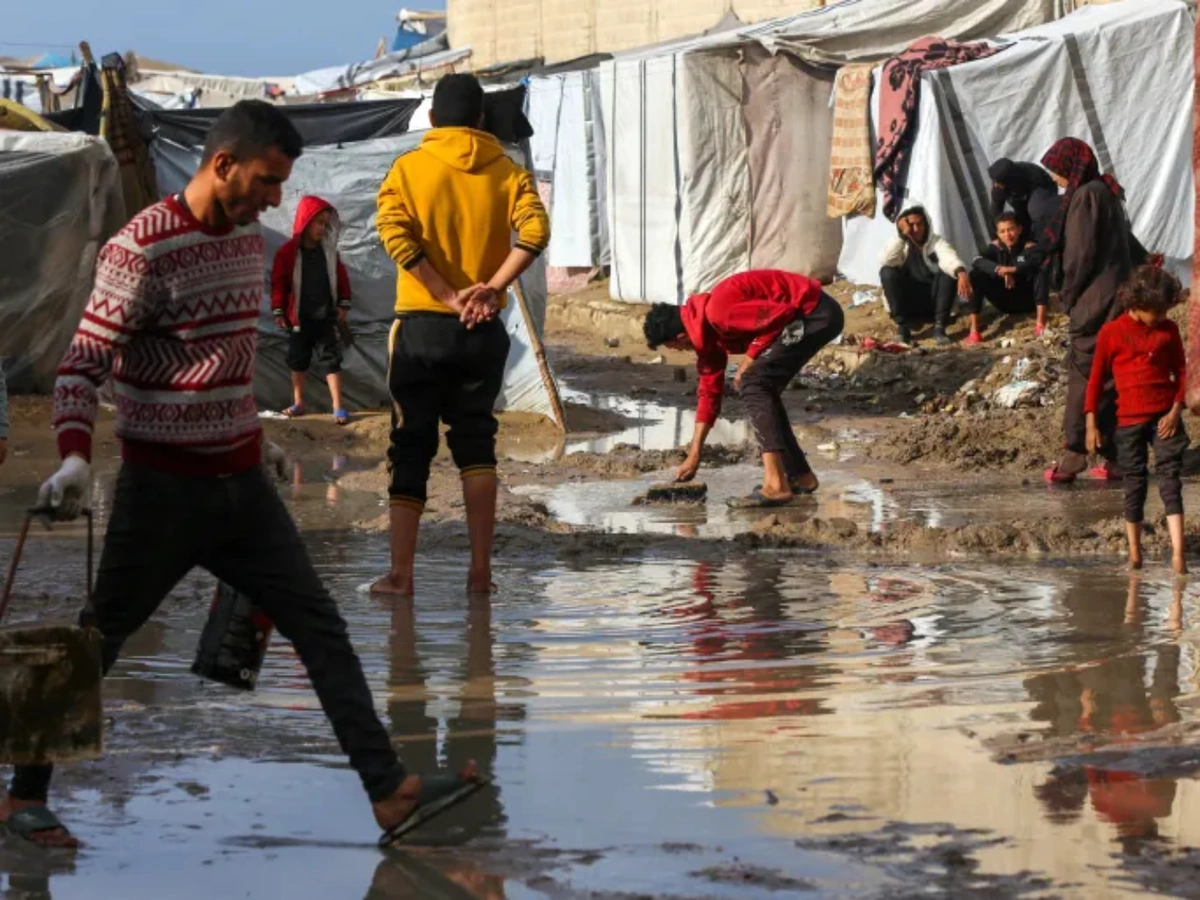
Gaza’s Hamas-run health ministry reported that a newborn baby had died of hypothermia, while at least 11 other people lost their lives in building collapses caused by the storms.
Heavy rainfall over the past week has worsened the already harsh living conditions faced by hundreds of thousands of displaced Palestinians in the Gaza Strip, according to UN agencies.
Unicef spokesperson Jonathan Crickx described the night’s weather as “terrible”, saying rainfall had been so intense that up to 15cm (6in) of water had gathered near his office.
Crickx expressed deep concern for children forced to survive in tents and makeshift shelters while wearing wet clothing, warning that hypothermia and other illnesses were becoming a serious danger.
Gaza’s Hamas-run health ministry reported that a newborn baby had died of hypothermia, while at least 11 other people lost their lives in building collapses caused by the storms.
Although UN organisations have increased the delivery of humanitarian aid such as tents, blankets and warm clothing since the ceasefire began nine weeks ago, they say the amount entering Gaza remains far below what is required.
Speaking to the BBC’s Today programme, Crickx said heavy winds and intense rain left large pools of water outside his office overnight, and that on his way to work he saw many people attempting to remove water from their tents using buckets.
He reminded that around one million Palestinians are currently living in temporary shelters made from tarpaulin and plastic sheeting, many of them having been displaced multiple times over the two-year war between Israel and Hamas. Because families have few spare clothes, keeping warm and dry has become almost impossible.
“With night temperatures falling to around 7C or 8C (45-46F), we are very worried that children may fall seriously ill or even die from cold exposure,” he said.
Many shelters are also at high risk of collapse or being blown away due to strong winds, as they are often built from thin plastic covers fixed to fragile wooden frames.
Crickx noted that although Unicef had managed to bring in more assistance during the ceasefire – including 250,000 winter clothing kits, 600,000 blankets and 7,000 tents – the needs are still overwhelming. He said thousands of families continue to suffer every night despite continuous efforts to distribute aid.
The Hamas-run health ministry said a two-week-old infant, Mohammed Abu al-Khair, died on Monday after being admitted to intensive care with hypothermia. It also reported that 11 others had died in collapsing buildings damaged by previous airstrikes.
Mahmoud Bassal, a spokesman for Gaza’s Civil Defence, put the total number of deaths even higher, saying 17 people, including four children, had died due to cold conditions and building failures. He said 17 structures had collapsed completely and a further 90 had partially fallen.
On Tuesday, footage emerged from Shati refugee camp showing first responders recovering a man’s body from the rubble of a collapsed house.
A relative of the man, Ahmed al-Hosari, called for international action to rebuild destroyed homes so people would not be forced to live in the streets.
The International Committee of the Red Cross described the collapse of weather-damaged buildings as “deeply alarming” and stressed that Gaza urgently needs sustained humanitarian support, including shelter materials and supplies to repair essential infrastructure.
Cogat, the Israeli military body overseeing Gaza’s border crossings, rejected allegations that Israel was restricting aid, saying hundreds of aid trucks continue to enter Gaza daily along with tents, tarpaulins, blankets and warm clothing.
UN figures, however, show lower totals, reporting that around 67,800 tents, 372,500 tarpaulins and over 318,000 bedding items have been collected from crossings since the ceasefire began.
The second phase of the ceasefire deal between Israel and Hamas includes plans for Gaza’s reconstruction, Israeli troop withdrawal, disarming of Hamas, and a new governance structure for the territory.
Israel’s prime minister recently said the transition to this next phase was close, with only the body of one Israeli hostage still to be returned under the current stage of the agreement.
The war erupted following the Hamas-led assault on southern Israel on 7 October 2023, which killed around 1,200 people and resulted in 251 hostages being taken.
Since then, Gaza’s health ministry says more than 70,600 Palestinians have been killed in Israeli attacks.
Related News
You may like




Tom Holland Says Marvel Has a Plan for the Next Spider-Man
August 1, 2026
Elected News
-
Bangladesh Seeks UN Women Support on Digital Harassment and Women’s Empowerment
-

Bangladesh, Australia Discuss Human Trafficking, Irregular Migration and Rohingya Crisis
-

Bangladesh Plans Internet-Free Access to Mobile Banking and Financial Apps
-

DU to Open Undergraduate Admission Applications on 11 November, Tests Begin 5 December


