Bangladesh Adopts Zero-Tolerance Policy Against Human Trafficking and Online Scam Networks
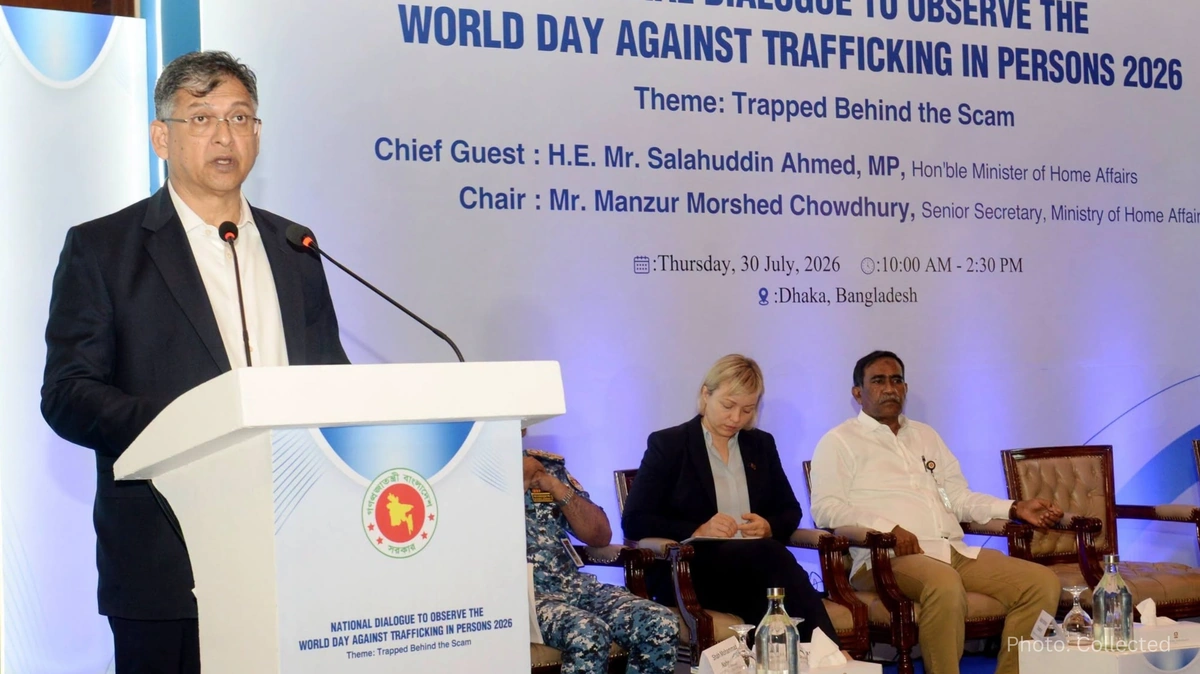
Home Minister Salahuddin Ahmed says the government is strengthening laws, victim support systems and international cooperation to combat human trafficking, forced criminality and cyber-enabled exploitation.
The Bangladesh government has reaffirmed its commitment to combating human trafficking and technology-driven transnational scam networks, with Home Minister Salahuddin Ahmed announcing a zero-tolerance policy against crimes that exploit vulnerable citizens through deceptive recruitment and online fraud.
Speaking at a high-level national dialogue titled "Trapped Behind the Scam: Ending Human Trafficking for Forced Criminality" in Dhaka on Thursday, the minister said protecting citizens from trafficking and cyber-enabled exploitation remains one of the government's highest priorities.
The event was held at the Pan Pacific Sonargaon Hotel to mark World Day Against Trafficking in Persons 2026 and brought together senior government officials, diplomats, law enforcement agencies and international development partners.
Salahuddin Ahmed warned that trafficking networks are increasingly relying on fake overseas job advertisements, fraudulent recruitment agencies and social media platforms to lure job seekers, particularly young people seeking employment abroad.
According to the minister, many victims are later transported to foreign countries where they are confined in cyber scam centres and forced to participate in illegal online activities under threats, intimidation and physical abuse.
He said the changing nature of trafficking requires a broader response than conventional policing alone, stressing the importance of stronger collaboration between government agencies, technology companies, financial institutions, the private sector and civil society organizations.
Highlighting recent legal reforms, the minister said Bangladesh has enacted the Human Trafficking and Migrant Smuggling (Prevention and Suppression) Act, 2026, which aligns with the United Nations Convention against Transnational Organized Crime (UNTOC) and its related protocols.
The new legislation expands legal provisions to specifically address online scam-related trafficking, technology-enabled deception and forced criminality while introducing stricter penalties for offenders.
Salahuddin also announced that the government is revising the Human Trafficking Prevention and Suppression Rules, 2017, alongside finalising the National Action Plan for 2026-2030. The strategy is expected to focus on four key pillars: prevention, protection, prosecution and partnership.
As part of efforts to improve victim assistance, the government is strengthening the National Referral Mechanism (NRM) to ensure rescued victims receive timely legal aid, healthcare, psychological counselling and rehabilitation services.
The minister further revealed that authorities are developing a digital trafficking information management platform to improve case monitoring, strengthen data collection and support evidence-based policymaking.
He called on the media, educational institutions and civil society organizations to increase public awareness, particularly among young people, women and prospective migrant workers, about the dangers of fraudulent recruitment schemes and the importance of safe migration practices.
The national dialogue was chaired by Senior Secretary of the Ministry of Home Affairs Manzur Morshed Chowdhury and attended by senior representatives from law enforcement agencies, government ministries and international organizations.
Among the participants were representatives from the European Union, the International Organization for Migration (IOM) and the United Nations Office on Drugs and Crime (UNODC), alongside senior officials from the Bangladesh Police, Border Guard Bangladesh (BGB) and the Bangladesh Coast Guard.
The programme also featured a panel discussion examining emerging forms of trafficking linked to forced criminality, deceptive recruitment practices and online exploitation. Speakers emphasized the growing complexity of trafficking networks and underscored the need for stronger regional and international cooperation to dismantle criminal organizations operating across borders.
Officials concluded the event by reaffirming Bangladesh's commitment to enhancing legal frameworks, expanding victim protection mechanisms and strengthening partnerships to combat modern forms of human trafficking in an increasingly digital world.
Related News



You may like




Tom Holland Says Marvel Has a Plan for the Next Spider-Man
August 1, 2026
Elected News
-
Bangladesh Seeks UN Women Support on Digital Harassment and Women’s Empowerment
-
Bangladesh, Australia Discuss Human Trafficking, Irregular Migration and Rohingya Crisis
-
Bangladesh Plans Internet-Free Access to Mobile Banking and Financial Apps
-
DU to Open Undergraduate Admission Applications on 11 November, Tests Begin 5 December


