Chhatra Dal Surrounds EC Alleging Political Influence Over Decisions
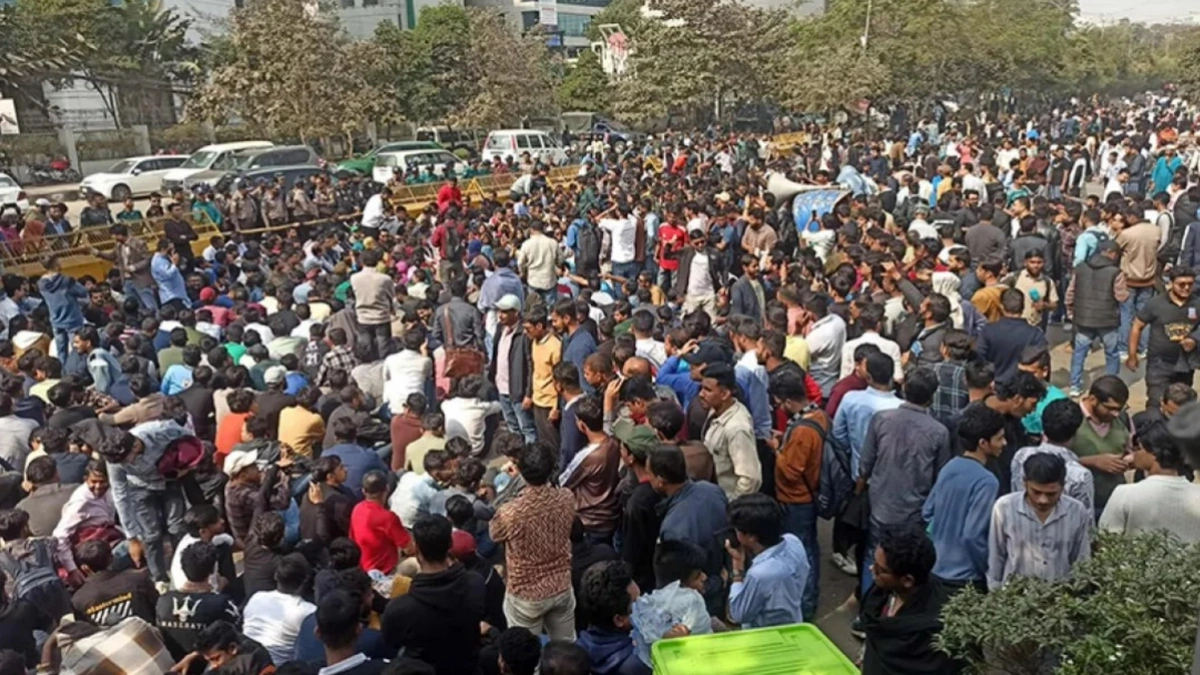
Hundreds of Jatiotabadi Chhatra Dal activists staged a protest around the Election Commission in Dhaka, alleging biased decisions on postal ballots and political interference, prompting heightened security deployment.
Jatiotabadi Chhatra Dal (JCD) activists on Sunday surrounded the Election Commission building in Agargaon, Dhaka, protesting what they described as political influence and biased actions by the commission, particularly over the handling of postal ballots.
Hundreds of protesters gathered in front of and around the EC premises, positioning themselves outside the official security cordon and chanting slogans. The demonstration was led by Rakibul Islam, president of Jatiotabadi Chhatra Dal.
In response to the protest, law enforcement agencies significantly strengthened security in and around the EC complex. Members of the police, navy, Rapid Action Battalion (RAB), and Ansar were deployed, while riot-control vehicles and water cannons were positioned nearby to prevent any disruption to law and order.
Chhatra Dal said the protest was organised on three main grounds: alleged biased and questionable decisions regarding postal ballots; claims of political interference in the EC’s decision-making process; and the issuance of what it termed an unprecedented and controversial notification concerning the student union election at Shahjalal University of Science and Technology, allegedly under pressure from a particular political group.
Addressing the gathering, Rakibul Islam alleged that a specific political group had exerted undue influence over the postal ballot process and that the Election Commission acted in line with that influence. He claimed the commission’s actions had repeatedly humiliated student organisations, drawing parallels with past controversies surrounding student union and hall elections at Shahjalal University.
He also criticised the postal ballot distribution mechanism, comparing it to letters being left at a common point in student dormitories for anyone to collect. He alleged that around 160 ballots were kept in a single box and later distributed among expatriate voters, raising concerns over ballot secrecy and integrity.
The protest followed widespread debate after a video showing a large number of postal ballots delivered to a single address in Bahrain circulated widely on social media.
In response to the controversy, the Election Commission issued a clarification on January 14. EC Secretariat Senior Secretary Akhtar Ahmed said postal ballots are sent through the Universal Postal Union, noting that postal delivery systems vary by country. He explained that in Bahrain, ballots were placed together in a single location due to local postal practices, not as a result of any irregularity by the commission.
Hundreds of protesters gathered in front of and around the EC premises, positioning themselves outside the official security cordon and chanting slogans. The demonstration was led by Rakibul Islam, president of Jatiotabadi Chhatra Dal.
In response to the protest, law enforcement agencies significantly strengthened security in and around the EC complex. Members of the police, navy, Rapid Action Battalion (RAB), and Ansar were deployed, while riot-control vehicles and water cannons were positioned nearby to prevent any disruption to law and order.
Chhatra Dal said the protest was organised on three main grounds: alleged biased and questionable decisions regarding postal ballots; claims of political interference in the EC’s decision-making process; and the issuance of what it termed an unprecedented and controversial notification concerning the student union election at Shahjalal University of Science and Technology, allegedly under pressure from a particular political group.
Addressing the gathering, Rakibul Islam alleged that a specific political group had exerted undue influence over the postal ballot process and that the Election Commission acted in line with that influence. He claimed the commission’s actions had repeatedly humiliated student organisations, drawing parallels with past controversies surrounding student union and hall elections at Shahjalal University.
He also criticised the postal ballot distribution mechanism, comparing it to letters being left at a common point in student dormitories for anyone to collect. He alleged that around 160 ballots were kept in a single box and later distributed among expatriate voters, raising concerns over ballot secrecy and integrity.
The protest followed widespread debate after a video showing a large number of postal ballots delivered to a single address in Bahrain circulated widely on social media.
In response to the controversy, the Election Commission issued a clarification on January 14. EC Secretariat Senior Secretary Akhtar Ahmed said postal ballots are sent through the Universal Postal Union, noting that postal delivery systems vary by country. He explained that in Bahrain, ballots were placed together in a single location due to local postal practices, not as a result of any irregularity by the commission.
Related News
You may like




Tom Holland Says Marvel Has a Plan for the Next Spider-Man
August 1, 2026
Elected News
-

Bangladesh Seeks UN Women Support on Digital Harassment and Women’s Empowerment
-

Bangladesh, Australia Discuss Human Trafficking, Irregular Migration and Rohingya Crisis
-

Bangladesh Plans Internet-Free Access to Mobile Banking and Financial Apps
-
DU to Open Undergraduate Admission Applications on 11 November, Tests Begin 5 December


