Dhaka Division Records Highest Unemployment, Graduates Top the List
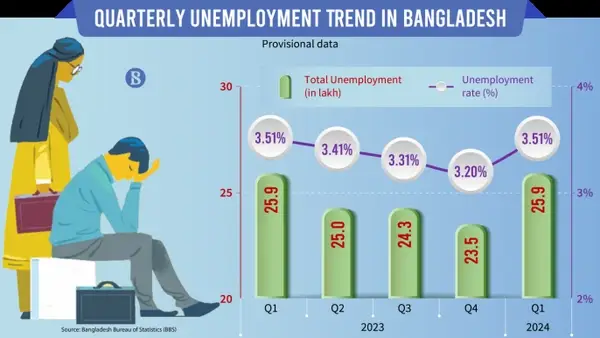
Dhaka division has the highest number of unemployed people in the country. The division accounts for 687,000 jobless individuals, followed by Chattogram with 584,000 and Rajshahi with 357,000. The final report of the 2024 Labour Force Survey was released today (Thursday) by the Bangladesh Bureau of Statistics (BBS). Division-wise, after Dhaka, the number of unemployed stands at: Chattogram 584,000; Rajshahi 357,000; Khulna 331,000; Sylhet 216,000; Rangpur 206,000; Barishal 139,000; and Mymensingh 104,000.
According to the ILO definition, anyone working at least one hour a week for wages is not considered unemployed. Those actively seeking work for a month but unable to find even one hour of paid work in the past week are counted as unemployed. By this definition, Bangladesh has 2.62 million unemployed people. But in reality, surviving on just one hour of work per week is impossible.
In addition, about 10 million people are underemployed, meaning they cannot find work matching their skills or desired hours.
In developed countries, the situation differs. There, even if people work just one hour a week, they receive not only wages but also unemployment benefits from the state, making it easier to cover living expenses.
Graduates Face the Highest Unemployment
Educated youth are hit hardest. According to the BBS survey, 13.5% of the unemployed hold a bachelor’s degree, while 7.13% have completed higher secondary education. In other words, 1 in every 5 unemployed individuals is either a graduate or an HSC certificate holder.
Those with little or no formal education face the lowest unemployment only about 1.25% of the unemployed belong to this group.
Among youth aged 15–29, unemployment is particularly severe. Nearly 2 million young people are unemployed, accounting for 76% of the country’s total jobless population. The unemployment rate in this age group is the highestover 8%.
Notably, 29% of unemployed youth (aged 15–29) are graduates. This means roughly one in three graduates is unemployed.
Job-Hunting Methods
The survey identified 10 ways jobseekers look for work. About 36% rely on family and friends for job opportunities, 26% search through newspaper ads, and 12% directly approach offices and institutions.
Three Types of Unemployment
Economists broadly classify unemployment into three types:
-
Frictional/Imbalance Unemployment arising when there is a mismatch between supply and demand in the labour market. This is common in northern and haor (wetland) regions, where the available workforce does not match industry needs.
-
Cyclical Unemployment caused by economic fluctuations. For instance, joblessness rose sharply during the COVID-19 pandemic.
-
Structural Unemployment triggered by technological change, which renders certain skills obsolete.
Related News
You may like



Tom Holland Says Marvel Has a Plan for the Next Spider-Man
August 1, 2026
Elected News
-
Bangladesh Seeks UN Women Support on Digital Harassment and Women’s Empowerment
-

Bangladesh, Australia Discuss Human Trafficking, Irregular Migration and Rohingya Crisis
-
Bangladesh Plans Internet-Free Access to Mobile Banking and Financial Apps
-
DU to Open Undergraduate Admission Applications on 11 November, Tests Begin 5 December


