Thousands Rally Against G7 Ahead of Summit as Global Leaders Gather in France
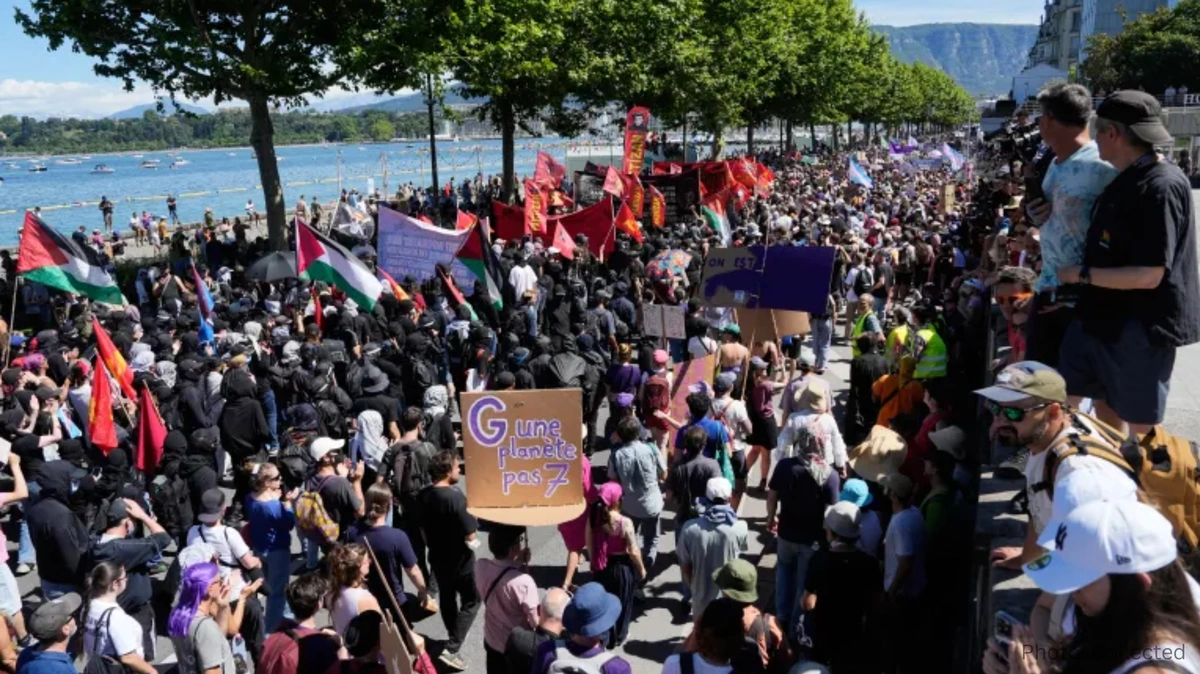
Thousands of demonstrators marched through Geneva ahead of the G7 summit in neighbouring France, voicing opposition to the policies of the world's wealthiest democracies and expressing concerns over war, climate change, inequality, and global representation.
Thousands of protesters took to the streets of Geneva on Sunday ahead of this week's Group of Seven (G7) summit, where United States President Donald Trump and other leaders of the world's leading industrialised nations are scheduled to convene in neighbouring France.
The demonstration, organised by the "No-G7" coalition, brought together a diverse alliance of more than 60 organisations, including environmental groups, feminist movements, Palestinian solidarity advocates, anti-war activists and social justice campaigners. Protesters marched through the Swiss city carrying banners and placards condemning what they described as the unequal and harmful policies pursued by G7 nations.
Many demonstrators argued that the G7 no longer reflects the interests of the wider global population and accused the bloc of prioritising the interests of wealthy nations at the expense of developing countries.
"We are very afraid of the policy and the politics of Mr Trump and also of the other leaders of the G7, because they are fighting, making war all over the place," said Francoise Nyffeler, a spokesperson for the No-G7 coalition.
"The planet is in danger, and we are very scared about it and we want to protest and say that the people of the world are against their policies," she added.
This year's summit is set to begin on Monday in the French resort town of Evian-les-Bains and will run for three days. Leaders from the United States, Canada, the United Kingdom, France, Germany, Italy and Japan are expected to discuss a range of pressing international issues, including economic cooperation, geopolitical tensions, trade disputes, security concerns and climate commitments.
Authorities in both Switzerland and France have implemented extensive security measures in anticipation of potential unrest. Thousands of police officers have been deployed across the region, while roads have been closed and restrictions placed on unauthorised public gatherings.
Businesses located near areas expected to host demonstrations have taken precautionary measures by boarding up storefronts. Many residents and shop owners remain cautious, recalling the violent scenes and property damage that accompanied anti-G7 protests during the Evian summit in 2003.
Beyond opposition to individual leaders, protesters questioned the legitimacy and relevance of the G7 itself in an increasingly multipolar world. Critics argue that although the bloc once dominated the global economy, its influence has gradually diminished.
Historically, G7 countries accounted for nearly 70 percent of global gross domestic product. Today, that figure has declined to around 40 percent, despite the group representing only a small fraction of the world's population. Activists say this imbalance raises important questions about who gets to shape international policies affecting billions of people.
At the same time, alternative global alliances have gained prominence. The BRICS grouping, which includes major emerging economies such as Brazil, Russia, India, China and South Africa, has expanded significantly in recent years, doubling its membership from five countries to eleven. Many analysts view this expansion as evidence of shifting geopolitical influence and changing global power structures.
This year's protests also come amid heightened international criticism surrounding several major issues, including escalating conflicts in the Middle East, ongoing trade disputes, and concerns over climate action. Demonstrators accused world leaders of failing to address widening inequality, poverty and environmental degradation.
Activists had been mobilising for several days before Sunday's main march. On Saturday, a flotilla of approximately 20 boats appeared on Lake Geneva near Evian, displaying anti-G7 and pro-Palestinian banners. Local media also reported that around 20 protesters were detained by Swiss authorities during demonstrations on Friday evening.
Despite differing priorities among participating groups, the central message of the Geneva protests remained consistent: a demand for greater accountability, inclusivity and fairness in global decision-making.
As world leaders prepare to begin formal discussions inside the summit venue, thousands gathered outside have sought to remind them that decisions made by a small group of powerful nations carry consequences far beyond their borders.
Whether the demonstrations influence the summit's agenda remains uncertain, but they have once again highlighted the growing public debate over who should shape the future of global governance in an increasingly interconnected and rapidly changing world.
Related News


You may like




Tom Holland Says Marvel Has a Plan for the Next Spider-Man
August 1, 2026
Elected News
-
Bangladesh Seeks UN Women Support on Digital Harassment and Women’s Empowerment
-

Bangladesh, Australia Discuss Human Trafficking, Irregular Migration and Rohingya Crisis
-

Bangladesh Plans Internet-Free Access to Mobile Banking and Financial Apps
-
DU to Open Undergraduate Admission Applications on 11 November, Tests Begin 5 December


