Chinese Scientists Help Paralyzed Patients Walk Again Using Groundbreaking Brain-Spine Interface Technology
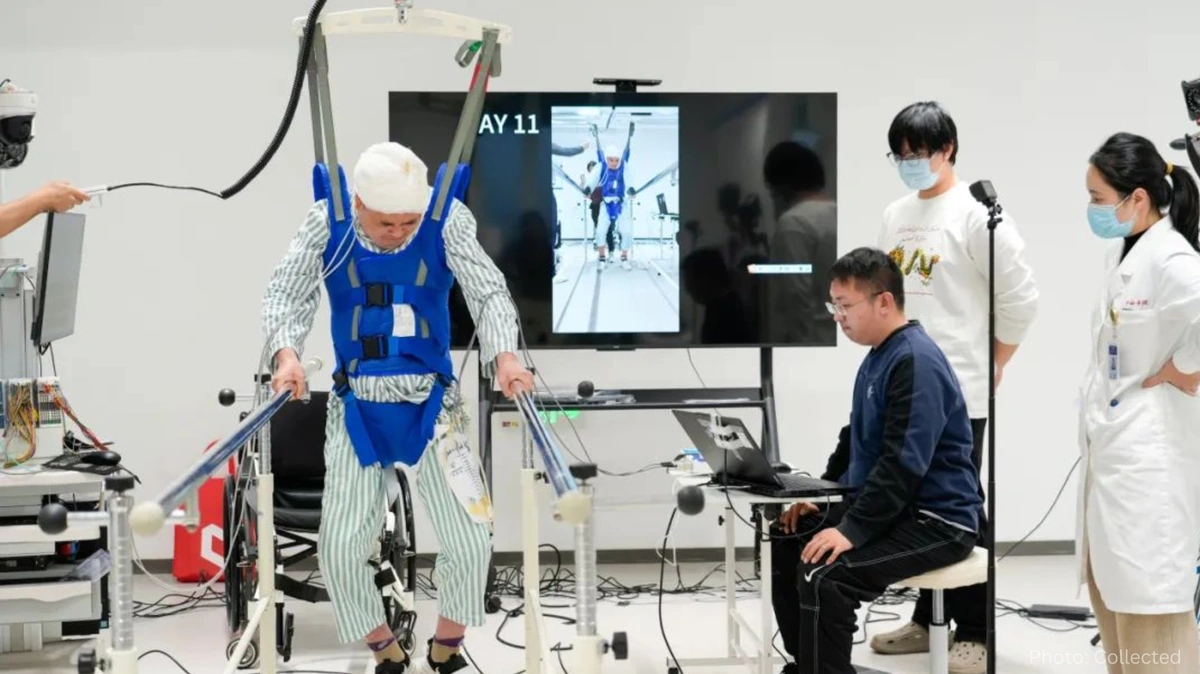
A team of Chinese researchers has successfully restored walking ability in paralyzed patients through a minimally invasive brain-spine interface system, marking a major breakthrough in the treatment of spinal cord injuries.
Chinese scientists and surgeons have achieved a significant medical milestone by enabling paralyzed patients to regain the ability to stand and walk through an advanced brain-spine interface (BSI) technology. The breakthrough, developed through a collaboration between Shanghai's Zhongshan Hospital and Fudan University, represents a major step forward in the treatment of severe spinal cord injuries.
Researchers announced that a patient suffering from complete paraplegia was able to stand and walk within 24 hours after undergoing a minimally invasive surgical procedure. The operation is believed to be the world's first successful clinical application of a brain-spine interface system that allows a person with total paralysis of the lower limbs to regain movement through direct communication between the brain and spinal cord.
The innovative technology was jointly developed by a multidisciplinary team led by Professor Wang Xin and Professor Ding Jing of Zhongshan Hospital, along with Professor Jia Fumin from Fudan University's Institute of Science and Technology for Brain-Inspired Intelligence. The project focuses on evaluating the safety and effectiveness of epidural electrical stimulation (EES) in restoring motor functions among patients with spinal cord injuries.
Spinal cord injuries often interrupt the communication pathway between the brain and spinal neurons, resulting in partial or complete paralysis. Traditional rehabilitation methods have offered limited recovery options for patients with severe injuries, making the search for advanced neurological treatments a major priority in medical research.
To overcome this challenge, the research team developed a novel "three-in-one" brain-spine interface system. The technology creates a neural bridge that reconnects the brain and spinal cord through a combination of brain-signal collection, real-time decoding, and targeted electrical stimulation.
During the procedure, surgeons implanted two tiny electrode chips, each measuring approximately one millimeter in diameter, into the patient's motor cortex. These electrodes capture neural signals generated when the patient intends to move. Advanced algorithms then decode the signals and send targeted electrical impulses to specific nerve roots within the spinal cord, enabling the patient's legs to respond accordingly.
The entire surgery, including both brain and spinal interventions, was completed within four hours. Researchers reported that artificial intelligence played a crucial role in interpreting movement intentions and facilitating rapid rehabilitation.
One of the most complex aspects of the project involved developing algorithms capable of accurately decoding human movement intentions in real time. Scientists explained that even a slight delay between a patient's intention to move and the system's response could result in balance problems or falls.
After nearly three years of intensive research and development, the team succeeded in creating a real-time decoding system capable of translating neural activity into immediate physical movement. Researchers believe this achievement is one of the key technological breakthroughs behind the project's success.
Between January and February 2025, the research team completed three additional clinical proof-of-concept surgeries involving patients with severe spinal cord injuries. According to the researchers, these individuals regained varying levels of leg control and were able to walk within two weeks of their operations.
Medical experts involved in the project described the outcomes as highly encouraging, noting that patient recovery met or exceeded initial expectations. They said the successful completion of multiple procedures across different hospitals demonstrates that the technology can be replicated and potentially scaled for broader clinical use.
Researchers believe the innovation could transform treatment options for millions of people worldwide who suffer from paralysis due to spinal cord injuries. While further clinical trials and long-term evaluations are still required, the early results suggest that brain-spine interface technology could become a powerful new tool in neurorehabilitation medicine.
The research team plans to continue refining the technology, improving its precision and accessibility while expanding future clinical trials. Scientists hope the system will eventually help a larger number of patients recover mobility and regain independence, offering new hope to individuals and families affected by paralysis.
As advances in artificial intelligence, neuroscience, and biomedical engineering continue to converge, the success of China's brain-spine interface project highlights the growing potential of next-generation technologies to restore lost human functions and reshape the future of medical treatment.
Related News





You may like




Tom Holland Says Marvel Has a Plan for the Next Spider-Man
August 1, 2026
Elected News
-
Bangladesh Seeks UN Women Support on Digital Harassment and Women’s Empowerment
-
Bangladesh, Australia Discuss Human Trafficking, Irregular Migration and Rohingya Crisis
-
Bangladesh Plans Internet-Free Access to Mobile Banking and Financial Apps
-
DU to Open Undergraduate Admission Applications on 11 November, Tests Begin 5 December


