Bangladesh Bets on Chip Design Over Fabrication in Push to Build a Billion-Dollar Semiconductor Industry
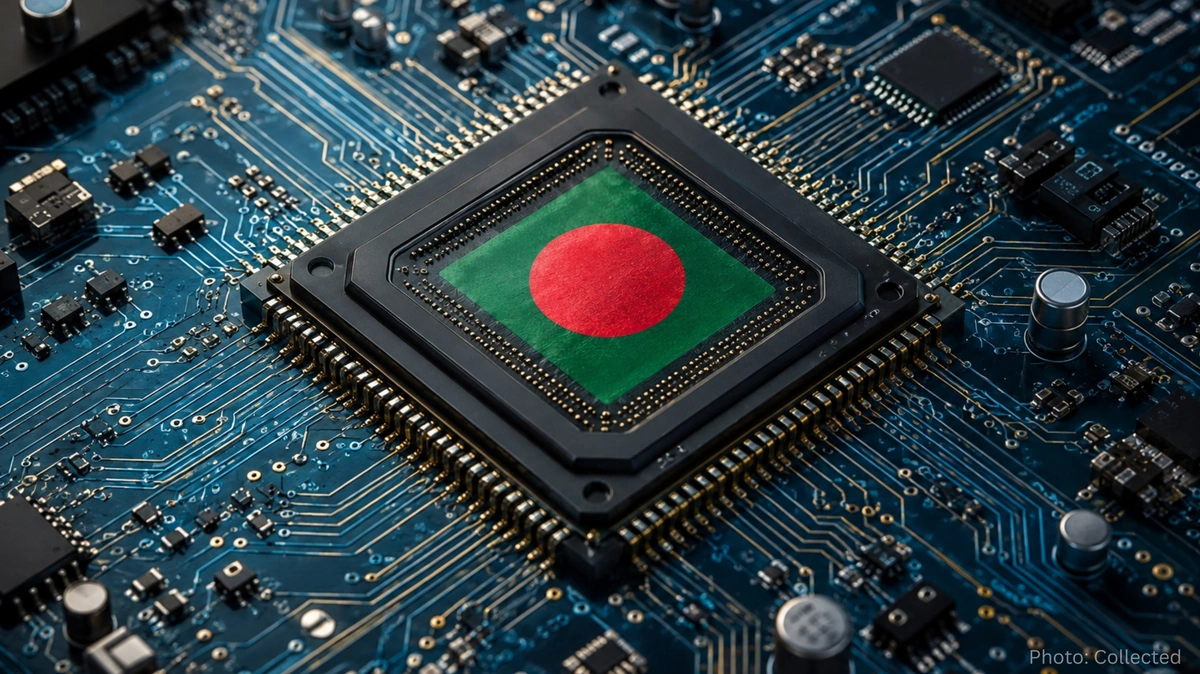
Bangladesh is prioritizing semiconductor design, testing, and packaging services instead of costly wafer fabrication, aiming to establish itself as a regional technology hub and expand the sector into a billion-dollar industry by 2030.
Bangladesh has adopted a strategic approach to enter the global semiconductor industry, choosing to focus on high-value chip design, testing, and packaging services rather than investing immediately in capital-intensive wafer fabrication facilities.
Industry leaders and technology experts say the decision reflects a realistic assessment of the country's strengths, particularly its growing pool of engineering talent. The strategy has received a significant boost through the government's latest fiscal measures, which provide long-term policy support and investment incentives for the sector.
Under the national budget for the 2026-27 fiscal year, the government extended major customs duty and value-added tax (VAT) exemptions on semiconductor-related technologies until June 2031. The incentives cover electronic design automation (EDA) tools, proprietary semiconductor design software, advanced packaging equipment, and specialized testing technologies.
According to industry stakeholders, the extended tax benefits provide the stability and predictability needed to attract both domestic and foreign investors. The government hopes the incentives will help transform a sector that currently generates around $8 million in annual export earnings into a $1 billion industry by the end of the decade.
The Bangladesh Investment Development Authority (BIDA) has identified integrated circuit (IC) design, outsourced semiconductor assembly and testing (OSAT), and advanced research and development activities as key priority areas for investment and expansion.
Bangladesh Semiconductor Industry Association (BSIA) President M.A. Jabbar described the policy as one of the most important developments for the country's emerging semiconductor ecosystem.
He noted that semiconductor investments require long-term planning and substantial commitment, making policy consistency critical for attracting global technology firms. According to industry leaders, extending the incentives through 2031 sends a strong signal that Bangladesh is serious about developing a competitive semiconductor sector.
Experts argue that wafer fabrication plants require billions of dollars in investment, advanced infrastructure, and decades of accumulated technological expertise. As a result, Bangladesh is focusing first on segments where it can compete more effectively, including IC design, design verification, FPGA and embedded systems development, semiconductor testing, and packaging engineering services.
Professor A.B.M. Harun-or-Rashid of the Department of Electrical and Electronic Engineering at Bangladesh University of Engineering and Technology (BUET), who is also a member of BIDA’s National Semiconductor Taskforce, said the tax incentives will significantly reduce costs for universities, startups, and entrepreneurs involved in chip design and semiconductor research.
He added that the measures are also expected to encourage investment in OSAT and semiconductor packaging operations, areas considered crucial for the industry's medium-term growth.
According to industry estimates, Bangladesh produces approximately 13,000 electrical and electronic engineering graduates and around 26,000 computer science graduates annually. Experts believe this growing talent pool gives the country a strong foundation for developing semiconductor design and engineering services.
The national semiconductor roadmap prioritizes chip design in the short term, testing and packaging in the medium term, and wafer fabrication as a long-term objective.
That strategy is already beginning to take shape. Several Bangladeshi technology firms, including Ulkasemi, Neural Semiconductor, Prime Silicon Technology, and Siliconova, are providing semiconductor design and engineering services to international clients.
These companies are involved in areas such as register-transfer level (RTL) design, design verification, physical design, analog and mixed-signal layout development, radio-frequency engineering, firmware development, and chip packaging support.
Industry representatives say Bangladeshi engineers are already contributing to advanced semiconductor projects involving technology nodes ranging from 180 nanometers to as small as 2 nanometers, demonstrating the country's growing technical capabilities.
Despite the positive momentum, experts caution that tax incentives alone will not be sufficient. One of the industry's biggest challenges remains the shortage of highly experienced engineers capable of leading complex chip design projects.
While universities produce thousands of engineering graduates each year, many require specialized Very Large Scale Integration (VLSI) training before becoming industry-ready. Experts have called for stronger collaboration between academia and industry, the establishment of centers of excellence, expanded access to professional EDA tools, and sustainable government-backed training programs.
Industry leaders also emphasize the need for advanced testing laboratories, packaging infrastructure, research funding, stronger intellectual property protection laws, and simplified incentive procedures to accelerate growth.
Global demand for semiconductors continues to rise rapidly, driven by artificial intelligence, electric vehicles, 5G networks, and industrial automation. Market analysts project that the worldwide semiconductor industry could exceed $1.3 trillion by 2026 and continue growing throughout the decade.
Although Bangladesh remains behind regional competitors such as India and Vietnam, experts believe the country has the potential to become a recognized regional hub for semiconductor design, verification, testing support, and engineering services by 2031.
Industry stakeholders envision a future where Bangladesh hosts dozens of VLSI design firms, multiple testing facilities, advanced packaging operations, and globally competitive semiconductor design centers, positioning the country as an emerging player in one of the world's most important technology sectors.
Related News





You may like




Tom Holland Says Marvel Has a Plan for the Next Spider-Man
August 1, 2026
Elected News
-
Bangladesh Seeks UN Women Support on Digital Harassment and Women’s Empowerment
-
Bangladesh, Australia Discuss Human Trafficking, Irregular Migration and Rohingya Crisis
-
Bangladesh Plans Internet-Free Access to Mobile Banking and Financial Apps
-
DU to Open Undergraduate Admission Applications on 11 November, Tests Begin 5 December


